In the Navy, there is a behavioral phenomenon known as getting an Ensign mobile. Ensign being the first officer rank in the Navy, and mobile meaning, well, a road-going vehicle. In short, an Ensign mobile is a car purchased by a new college graduate who recently commissioned as a Naval Officer. While the name is particular to the military, the idea behind it is not.
Every year, new college graduates sign themselves up for loans on new vehicles. It’s almost a right of passage, a step into adulthood, a statement that you’ve finally ‘made it’.
Well, I didn’t get an Ensign mobile. Before you pat me on the back, know that my desire for a new, cool car was certainly there just like with everyone else. However, thanks to money principles instilled by my parents from a young age, I resisted the urge to take out a loan for a new car. But a couple of years later, I made a very smart, very dumb decision.
In December 2009, I purchased a brand new Ford F150 SuperCrew Lariat. How was that simultaneously smart AND dumb? Let me explain.
According to conventional wisdom, you should always pay cash for a new car. So, I saved up my money over several years and PAID CASH for my 2009 Ford F150 SuperCrew Lariat. According to most voices I was listening to at the time, this was pretty smart, and I felt good about myself. Only later did I learn about the time value of money, the value of optionality, and other concepts that poke holes in the validity of this ‘wisdom’. But that’s not even the dumb part!
The dumb part? Well, that was buying a new car in the first place. You see, I didn’t NEED a new car. I didn’t even need a used car. The car I had was just fine. But somehow, I was unable the resist the siren song of our consumerism culture.
It wasn’t until six years later that I finally corrected my mistake, and I had several good reasons for doing so:
- I was traveling most of the week, every week, so I wasn’t even home much of the time
- When I was home, I was living downtown, so I was able to walk a lot of places that I needed to go
- My parking garage was designed for smaller cars, so getting in and out with a big truck was about like this:
At the end of the day, the benefit of having a fancy truck wasn’t enough to counteract the cost of having an unnecessarily expensive depreciating asset sitting unused for 99% of the week. With that decided, the first step on my journey was selling my truck.
While logically, a direct sale (to another driver) would get me more money than an indirect sale (to a dealer), due to my travel schedule with work, I wasn’t really able to accommodate the tire kickers from Craiglist and AutoTrader. So I decided to at least SEE what a dealership could do for me, expecting the worst but hoping for the best. I was able to take advantage of the USAA Car Selling Service to get the ball rolling. If you don’t bank with USAA, you can try Sell Mobile App from TrueCar. I’m assuming it is effectively the same service since USAA is an investor in and partner of TrueCar. Another choice is a similar service from Cars.com. These services send details and pictures of your car to local dealers, who then return purchase bids that you can accept or ignore with no obligation.
While you’re waiting on the bids, you need to get an idea of what you think your car is worth. I first started with browsing Craigslist and AutoTrader to get a feel for what dealers and private sellers were asking for cars similar to mine. Remember, these are asking prices, not transaction prices, and should be on the high end of your perceived value. I followed that up with a few free used car value guides from NADA, ClearBook, KBB, Cars.com BlackBook, and Edmunds, which should collectively form the low end of your perceived value.
With all of that information in hand, I established a price in my mind that I’d be willing to accept: $24,000.
Just for kicks, I decided to get an appraisal from Carmax. What a complete waste of time. On top of the time spent driving to and from the dealership, I wasted two hours waiting on them to do an appraisal. They finally presented me with an offer of $18,000. I wadded it into a ball, threw it in a trashcan, and walked out with them begging me to come back.
Soon after, I received an email with my first USAA Dealer offer:
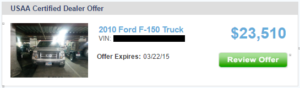
Better than Carmax, but below my target price. I waited a few weeks, and tried again:
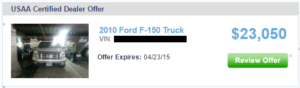
Even worse than before. I decided I’d give it one more shot after waiting a bit longer:
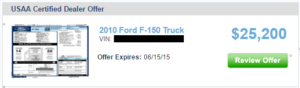
Success! I drove to the dealership, filled out some paperwork, and was out the door with a check in less than 30 minutes.
What’s the lesson learned here? Be patient. If you’re in a rush to buy or sell, you’re at the mercy of the other party. As you can see, three months went by before I got an offer I was happy with. While that may sound like a long time to wait, keep in mind that each additional attempt at soliciting purchase offers only took me about five minutes of work.
Could I have got more money by doing a private party sale myself? Maybe. But I was VERY happy with the price I got, and the lack of hassle was worth at least $500 to me.
With my truck sold, finding a new vehicle became an immediate priority. In a perfect world, I would have found a new vehicle first, but due to the lack of parking at my home, I couldn’t keep two vehicles while waiting on my truck to sell.
I’d already decided that I wanted a Jeep Grand Cherokee WJ, built from 1999 to 2004, as my replacement vehicle. The reasons why included:
- Huge depreciation – good for me, bad for the original owner
- Available V8 with 5sp automatic transmission that was capable of towing while getting decent MPG
- Luxurious, with heated leather seats and sunroof in the Limited model
- Produced in large numbers which meant plenty of replacement parts available and plenty of used inventory to search
When buying a ~15 year-old vehicle, the pricing guides become less relevant and you need to go more on your feel of the owner and understanding of the local market. A history of good maintenance is arguably more important than mileage or even year model. My local Craiglist had dozens of WJ’s to pick from, and after just a few days, I’d found a few to go see. The first two I looked at had a lot of underbody rust, likely signs they came from the northern US and were exposed to road salt. They also wanted what I decided was too much for them. But the third one I looked at was in great shape:
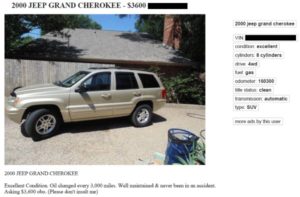
I offered $3400 and the seller accepted. I had a car again!
Let’s summarise…
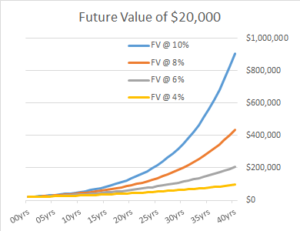
I sold a 2010 truck with 60k miles for $25,200 and bought a 2000 SUV with 160k miles for $3,400. While some may be unable to fathom this kind of trade-down, I’m happy with my decision. I’ve had to do several repairs over my two years and 13k miles of ownership, costing several hundred dollars and dozens of hours of my time. However, this has been a great opportunity to learn more about automotive repair, and is something that I planned on from the beginning. Additionally, I have a motorcycle so I’m able to get from A to B even if my car is not running. Obviously, the biggest benefit of this arrangement has been the $20k+ additional dollars I’ve had available to invest. This unlocked equity comes at the price of having to drive an older car with a lot of miles, which is undoubtedly less luxurious and less reliable than the truck I replaced. However, If I invested the $20,000 of equity I released at a nominal 6% rate of return over the 40-ish years until I’m of “traditional” retirement age, I’d have $205,714 (Ignoring the effects of inflation, $20,000*(1+0.06)^40). See the graph below for additional combinations of time horizons and rates of return.